
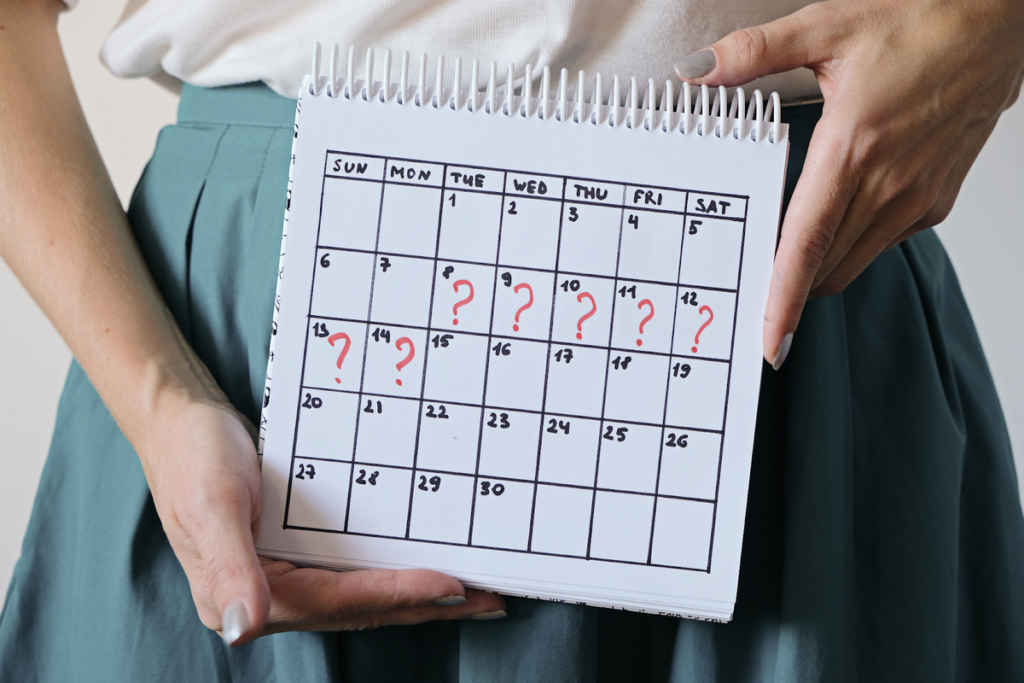
Use actual cycle dates to understand your cycle and estimated fertile days while keeping contraception decisions separate.
A period tracker provides the foundation for planning: it shows actual cycle lengths, helps identify a late period, and estimates fertile days. It can support pregnancy preparation or general cycle awareness, but it is not contraception.
What to do in practice
Record the first and last day of each period rather than only expected dates. Add symptoms that recur and matter to you. If you do not want pregnancy now, do not use an app estimate as your only birth-control method; discuss a reliable option with a professional.
What to keep in mind
Log the first and last day of each period
Start with facts you can confidently attach to a date. This keeps the cycle history useful even when estimates change.
If a date is approximate, say so in the note. An honest uncertainty marker is more useful than a precise-looking date reconstructed from memory.
Add symptoms and wellbeing changes in the context of the cycle day
Consistency matters more than the number of fields. A few short notes across several cycles usually provide more context than one highly detailed month.
Choose two or three details that matter for your current goal. They may be periods, wellbeing, and a prescribed supplement; everything else can remain optional.
Review several cycles before drawing conclusions
Review several cycles and keep observations separate from assumptions. An estimate is a useful guide, but it cannot confirm ovulation or conception.
Do not change treatment or contraception based on an app estimate. Medical decisions require professional guidance that fits your individual situation.
How to use your observations
Add short notes when it is convenient. A date, useful context, and change over time often help more than a long description of one day. Before an appointment, review the history and choose the questions you want to discuss.
You do not need to complete every field every day. Choose the notes that answer the article’s question and will be useful later. When an observation repeats, use consistent wording so changes are easier to see without adding assumptions.
What to prepare for a checkup
Before an appointment, choose the notes that best explain the question: when a change began, what happened around it, whether it repeated, and what has changed since. Add a medicine or supplement list when relevant and prepare two or three questions you want answered.
What an app cannot determine
A calendar or estimate cannot confirm ovulation, assess fertility, or predict pregnancy. Its role is to organize dates and observations you may choose to discuss with a clinician.
When to seek professional help
A period tracker organizes observations but does not confirm ovulation or replace a medical assessment.
Quick answers
How often should I add notes
Add a note when there is new information or something you follow changes. Daily tracking is only necessary when a professional recommends it or that rhythm genuinely works for you.
What if I missed several days
Continue from today. You do not need to reconstruct details you are unsure about. If an approximate date matters, label it as recalled from memory.
Which notes should I show a clinician
Choose notes that show when the question began, repeated, or changed, plus relevant medicines, supplements, and prior advice. Your clinician can tell you which observations are worth continuing.
How Olisora can help
Olisora lets you keep a cycle calendar, log symptoms, view estimated fertile days, and save questions for your clinician in one app.